Friday, July 15, 2022

Desiderio Desideravi: summary of key points in simple language

“Liturgy is of first importance in our lives. God must be in first place and prayer our first duty,” Pope Francis recently stressed in Desiderio Desideravi. And he pointed out that "it is important now to spread this knowledge" to "each one of the faithful" in "an accessible way." So here is a summary of the key points in simple language.


The Liturgy is the “today” of God’s saving work

From the beginning of creation, God has been preparing for the Last Supper of Jesus. 

Because Jesus has an infinite desire to become one with us, everyone is invited to that Supper. Here Jesus himself is the Passover Lamb that we take.

How great is the gift and how small we are.

The Mass is the supper of the wedding of the Lamb

To be present, there is one requirement: the wedding garment of faith.

Our response to Jesus’ desire is to surrender to his love, to let ourselves to be drawn by him.

The content of the Mass: the crucifixion of Jesus


This is the content of the broken bread: the cross of Jesus, his sacrifice of obedience out of love for the Father. The crucifixion is:

  • the act of perfect worship

  • the only true liturgy

The Eucharist is a memorial, a remembering of this cross where Jesus offers his body and pours out his blood.

In Emmaus, when Jesus breaks the bread in front of the disciples, he opens their eyes, making them see him as the Risen one.

There is no possibility of true encounter with Jesus other than the community that celebrates. Because what was visible in Jesus has passed on to his sacraments.

The Liturgy: place of encounter with Christ

In the Liturgy, we encounter Jesus and the power of his Paschal Mystery reaches us.

In the sacraments, the Risen Jesus continues to forgive us, heal us, and save us.

The Church is the sacrament of the Body of Christ

The Church came from the pierced side of Jesus, as Eve came from the side of the sleeping Adam.

We become part of the Church when we believe and are baptized. We become flesh of Jesus’ flesh.

There is only one act of worship: The obedience of Jesus, the Son of God who died on the cross. The only way to take part in this worship is to become “sons in the Son.” Because the only acting subject of the Liturgy is the Mystical Body of Christ: Christ and his Church.

The Liturgy is an antidote for the poison of spiritual worldliness


Beware of the dangerous temptation of “spiritual worldliness”.

Two present-day poisons feed this:

  • Gnosticism – one who is imprisoned by his own subjective thoughts and feelings

  • Pelagianism – a narcissist who does not need God’s gift of grace and believes he can save himself with his own efforts

The Liturgy is an antidote to these poisons:

  • It is an action of the whole Church and not of the individual

  • It is not our achievement but a gift. In it, we only boast of the cross of Christ

Let us rediscover the beauty of the truth of the Christian celebration

For the antidote to work, we are required to rediscover the beauty of the truth of the Mass. 

For this:

  • Don’t be content with only exterior observance of the rite
  • Don’t be careless, superficial, and merely functional

Let us be clear:

  • Take care of every aspect: gestures, words, song, vestments

  • Observe every rubric (liturgical instruction)

An essential part of the Mass: being amazed at the Paschal Mystery


The Paschal Mystery—the passion, death, and resurrection of Jesus—is what is made present in the Eucharist.

An essential part of the Mass is to be astonished by the Paschal Mystery: God saves us through this deed and reveals his plan through this deed. And what happened 2000 years ago continues to reach us in the celebration of the sacraments, also called “mysteries.”

If we lack amazement, we risk not receiving the flood of graces.

Note: St. Padre Pio recommended: "With your mind's eye, transport yourself to Calvary." He also said: “If you want to assist at Mass with devotion and with fruit, think of the sorrowful Mother at the foot of Calvary.”

The need for a serious and vital liturgical formation

To fully live the liturgy is an extremely demanding challenge because we lack reference points and values (knowing what is truly important and first).

The first document of Vatican II is about the Liturgy. The reason for this, says St. Pope Paul VI, is that the Liturgy is the priority over all others. The liturgy is first in importance to the life of the Church.

  • Because God must hold first place; prayer to him is our first duty.
  • The liturgy is the first source of divine fellowship in which God shares his own life with us.
  • It is the first school and the first gift.
  • It is the first invitation that we give to all men.
  • It is “the summit toward which the activity of the Church is directed, and at the same time the source from which all her power flows.”

Let us spread this knowledge now in a simple language so all Catholics may see God in the liturgy--and put the Sunday Mass at the center of their life.  

The decisive point of our lives is the knowledge of the mystery of Christ. This is not a matter of ideas, but of a real engagement with Jesus. Liturgy is not about “knowledge,” but is about praise, thanksgiving, and docility to the Holy Spirit. The only goal is to become one with Jesus.

To be formed by the Liturgy, it is important that we become capable of symbols, to have an interior attitude to use and understand symbols.

Ars celebrandi: for all Catholics


The art of celebrating the Liturgy requires knowledge:

  • First, understand what is happening: the Paschal Mystery is made present, by means of memorial (remembering), so that we can experience it in our life. Without this understanding, we fall into problems.

  • Then, understand how the Holy Spirit and symbolic language work

Learn the art of celebrating through:

  • Discipline, not sentimental feelings

  • Serious work on your relationship with God, obeying the Church

All Catholics are called to live this attitude in all they do in the Mass: gathering, being seated, standing, kneeling, singing, being in silence, acclamations, looking, listening.

Take part in the celebration as one body. Everybody doing together the same gesture, everyone speaking together in one voice — this transmits to each individual the energy of the entire assembly.

All this puts order in our interior world, making us live specific feelings, attitudes, behaviors.

The art of celebrating is required of the entire assembly that celebrates.

Ars celebrandi: particular concern of the priest

Priests who preside in an inadequate way usually are too concerned to be the center of attention.

But the risen Lord is in the leading role. The priest should be overpowered by Jesus' desire to be united with each person. The priest is in the middle between Jesus’ burning heart of love and the heart of each of the faithful.

Silence is absolutely important

  • It is something grand: take extreme care of silence, one of our symbolic gestures

  • A symbol of the presence and action of the Holy Spirit

  • It moves us to sorrow and desire for conversion, makes us ready to hear the Word, awakens prayer, leads us to adore the Body and Blood

Liturgical year and the Lord’s Day: rediscover their meaning

  • The liturgical year makes us grow in our knowledge of the mystery of Christ, going deep into the mystery of His Death and Resurrection, awaiting his return in glory. This is a true ongoing formation.

  • On the Lord’s day we celebrate the event of our salvation. Sunday is a gift that God gives to his people.

Read the entire document here at the Vatican website. The Spanish version, which probably is the original, is here.

Relevant materials:


Monday, July 4, 2022

Answers to some attacks against Pope Francis


Recently a priest who was dismissed by Opus Dei with the approval of Pope Francis, has come up with a four-point attack against the Holy Father. 

His continued attacks, the very reason for his dismissal, have been answered by many erudite people.

Here are their replies:

1. Coexistence laws for homosexuals. Eminent authors, Ryan Anderson and Robert George, wrote that "there is nothing intrinsic to a civil union (a legal fiction created by positive law) that has to conflict with moral reality." They quote Archbishop Cordilione, the bishop who refused communion to Nancy Pelosi, as saying that a civil union will have to "be as inclusive as possible," and can benefit a brother and sister for their mutual support. 

Their article at the Catholic Education Resource Center has a deep analysis of context and theology. 

2. Communion for pro-abortion politicians. Fr. Raymond de Souza, in National Catholic Register, pointed out the words of Pope Francis to put in context what he said during the in-flight interview: "It’s homicide, whoever has an abortion, kills...the Church is so harsh on this issue, because if it accepts this, it is as if it accepts daily murder." He quoted the words of the future Pope Francis in 2010: people who have “devastated the lives of many persons cannot receive Communion.”

Regarding the recent communion of Nancy Pelosi at the Vatican, John Allen, Jr. in Crux clarified: "To be clear, Pelosi did not receive communion directly from Pope Francis, who did not preside over the liturgy due to his ongoing knee issues, but rather restricted himself to delivering the homily. Instead, like everyone else, Pelosi took communion from an unidentified priest assisting at the Mass, who very well may not even have known who she was."

To say that Pope Francis "certainly, consciously and premeditatedly" allowed Nancy Pelosi to receive communion is not just grave slander, but grave rash judgment. 

3. Hysterectomy. The National Catholic Bioethics Center concluded its analysis of the CDF statement, saying: "Nothing contained in the 2018 responsum can be properly understood as modifying previous Church teachings." 

4. Propose continence. An article from Obey the Pope examines the use of the word "propose" in the Church, and quotes St. John Paul II's indication: "On her part, the Church addresses people with full respect for their freedom. Her mission does not restrict freedom but rather promotes it. The Church proposes; she imposes nothing."

The context is the pastoral approach of the bishops of Buenos Aires "instructing priests on the circumstances in which they can propose the commitment to continence. It is implied but not explicitly stated that a priest should not propose the commitment to continence if it is not feasible. ... Nothing in the Buenos Aires guidelines authorizes a priest to propose something other than Church teaching."


Catholics who are confused with some issues raised in the internet may find answers by searching in sites faithful to the Magisterium and have a high level of critical analysis, for example those cited in the links above. The Catholic Education Resource Center (CERC), which you can find here, is especially good. 

It is important not to take part in the spread of attacks and doubts about the teachings of Pope Francis, lest we "become an accomplice of evil"--as the pope himself warned as regards "fake news". He also quoted St. Francis: "Where there is ambiguity, let us bring clarity." 

Please continue to pray for the Holy Father and his intentions, so people may understand how the grace of the papacy continues to support Pope Francis in his task of leading the Church founded by Jesus--who chose St. Peter as the Rock on which to build his Church, and as the shepherd who will feed his sheep. (cf Mt 16:18; Jn 21:15-17)

To adhere to this truth, we need faith. As St. Josemaria loves to repeat as regards problematic situations: "It is a matter of faith." 

Related article:  Heretic Francis?  On Amoris Laetitia and the view of Benedict XVI and the teachings of St. Thomas. 

Note: I wrote these in my personal capacity as a theologian and author of Jesus-Centered: Guide to the Happiest Life. 


Saturday, July 2, 2022

WHAT'S WRONG WITH MASONRY?

Its ultimate aim is to overthrow Christianity, to be a rival religion that denies supernatural revelation

Freemasonry | Definition, History, Stages, Lodges, & Facts | Britannica
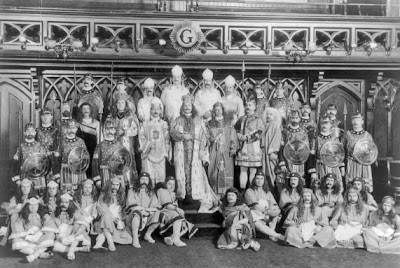
Masons in Ceremonial Dress


For mass distribution of printed copies, download this as a one-page leaflet here.


Catholic teaching on Masonry: grave sin

Masonry is incompatible, “irreconcilable with the Church’s doctrine.”  

“Joining them remains prohibited by the Church. Catholics enrolled in Masonic associations are in a state of grave sin.” (Declaration on Masonic Associations, Congregation for Doctrine of the Faith 1983 with approval of St. John Paul II)


Why is joining Masonry a “grave sin”?

Many join Masonry as a social club that fosters fraternal links and mutual help. A number do not know these negative facts: 

  • Secret society. Masonry is “the largest worldwide secret society—an oath-bound society…that conceals at least some of its rituals, customs, or activities from the public.” (Britannica)
  • Ultimate aim: Overthrow of Christianity. Its “ultimate aim” is the “overthrow” of the Christian “religious and political order of the world.” (Pope Leo XIII)
  • Rival to Christianity. It is “a rival to the religion of the Gospel. It includes temples and altars, prayers, a moral code, worship, vestments, feast days, hierarchy and burial rites.” (New Catholic Encyclopedia)
  • Hostile actions against the influence of the Church. “Masonry has consistently advocated and actively promoted the exclusion of Catholicism from any position of influence, however legitimate, in almost every walk of life.” (CBCP)

Standard image of masonic square and compasses

G = God, Great Architect or Geometry

  • False teachings: God is “the great architect” of the world but he leaves it on its own. And so Jesus is not God, only a man; there is no objective moral truth; and one religion is as good as another. Man has no supernatural destiny; his only goal is to develop his natural powers. (CBCP)
  • Introduction of anti-Christian government policies. “Masonic plot or agenda against the Church includes marriage as a merely civil contract open to divorce at will, abortion, exclusion of religious education from public schools.” (Ed Condon in Catholic Herald)
  • Hostility against the sacraments. “Priests have been prevented by Masons from hearing the confession of Masons on their death bed.” (CBCP) 

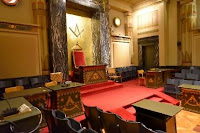
Masonic Lodge

What are sanctions against Masons? 

The Church says that Catholics "enrolled in Masonic associations...may not receive Holy Communion." In the Philippines, deeply convinced Masons may not receive the last rites unless they repent; they may not be a sponsor in Baptism and Confirmation, and a member of a Catholic organization.


What are alternatives to Masonry?


Alternatives are the Knights of Columbus, Rotary, and many Catholic associations and organizations.


For mass distribution of printed copies, download this as a one-page leaflet here.


Another problem is that more Filipinos are becoming Protestant, and the Philippines is becoming less Catholic, A one-page leaflet that dispels the ignorance at the root of this problem is found here: Ten Reasons the Catholic Church is the One True Church of Jesus, while other Christian groups derive their elements of truth from her fullness. Please share.


These one-page leaflets have started going viral around the world.  To get a collection of these Executive Summaries, please see this:  One Page Leaflets for New Evangelization Starting to Go Viral! Download here.


Monday, June 13, 2022

Inculturation in the Teachings of the Popes


The recent popes have been emphasizing inculturation because it makes us faithful to Jesus Christ who became man in a specific culture and who wants to be incarnate in specific cultures around the world. Inculturation, says Pope Francis, is evangelization. 


IMPORTANCE, NECESSITY AND URGENCY

  • Importance of understanding evangelization as inculturation. (Francis)

  • An uninculturated faith is not authentic. (Francis)

  • Inculturation is "a necessary process" that "rejects nothing of the goodness that already exists in cultures, but brings it to fulfilment in the light of the Gospel." (Francis)

  • Today inculturation is particularly urgent. (John Paul II)

  • Evangelization and inculturation constitute an inseparable pair, both elements of which must be present if the Gospel of Christ is truly to become incarnate in the lives of people of every race, nation, tribe and language. (Benedict XVI)


BASIS: EXAMPLE OF JESUS

  • The Church…must implant herself into these groups for the same motive which led Christ to bind Himself, in virtue of His Incarnation, to certain social and cultural conditions of those human beings among whom He dwelt. (Paul VI)

MEANING AND EFFECTIVENESS

  • Inculturation "means the intimate transformation of authentic cultural values through their integration in Christianity and the insertion of Christianity in the various cultures.”

  • The Church transmits to them her own values, at the same time taking the good elements that already exist in them and renewing them from within. 

  • Through inculturation the Church, for her part, becomes a more intelligible sign of what she is, and a more effective instrument of mission. (John Paul II)

GUIDING PRINCIPLES

  • Inculturation must be guided by two principles: "compatibility with the gospel and communion with the universal Church.”

  • A deeply balanced approach is required. (John Paul II)

  • Heal culture and avoid overestimating culture. There is a risk of passing uncritically from a form of alienation from culture to an overestimation of culture. Since culture is a human creation and is therefore marked by sin, it too needs to be "healed, ennobled and perfected.” (Francis)

  • Not forced. Inculturation needs to be guided and encouraged, but not forced, lest it give rise to negative reactions among Christians. It must be an expression of the community's life. (John Paul II)

  • Respect for customs. Enter into the life of the people of faith, enter with a respect for their customs, their traditions, seeking to carry out the mission of inculturating the faith and of evangelizing the culture. (Francis)

  • Evangelize culture and encourage the good. It is imperative to evangelize cultures in order to inculturate the Gospel. In countries of Catholic tradition, this means encouraging, fostering and reinforcing a richness which already exists.

  • Take up the positive values of each culture.  Every culture offers positive values and forms which can enrich the way the Gospel is preached, understood and lived. 

  • Heal specific deficiencies. In the case of the popular cultures of Catholic peoples, we can see deficiencies which need to be healed by the Gospel: machismo, alcoholism, domestic violence, low Mass attendance, fatalistic or superstitious notions which lead to sorcery, and the like. (Francis)

POPULAR PIETY

  • Popular piety is “a precious treasure of the Catholic Church”, in which “we see the soul of the Latin American peoples. (Benedict XVI)

  • Approach popular piety with the gaze of the Good Shepherd, who seeks not to judge but to love. Only from the affective connaturality born of love can we appreciate the theological life present in the piety of Christian peoples, especially among their poor. (Francis)

  • Popular piety “manifests a thirst for God which only the poor and the simple can know” and that “it makes people capable of generosity and sacrifice even to the point of heroism, when it is a question of bearing witness to belief.” (Paul VI)

  • Importance of understanding evangelization as inculturation. Each portion of the people of God, by translating the gift of God into its own life and in accordance with its own genius, bears witness to the faith it has received and enriches it with new and eloquent expressions. One can say that “a people continuously evangelizes itself”. Herein lies the importance of popular piety, a true expression of the spontaneous missionary activity of the people of God. This is an ongoing and developing process, of which the Holy Spirit is the principal agent. 

  • Underlying popular piety, as a fruit of the inculturated Gospel, is an active evangelizing power which we must not underestimate: to do so would be to fail to recognize the work of the Holy Spirit. Instead, we are called to promote and strengthen it, in order to deepen the never-ending process of inculturation. Expressions of popular piety have much to teach us; for those who are capable of reading them, they are a locus theologicus which demands our attention, especially at a time when we are looking to the new evangelization. (Francis)

INCULTURATED PREACHING AND CATECHESIS

  • The challenge of an inculturated preaching consists in proclaiming a synthesis, not ideas or detached values. Where your synthesis is, there lies your heart. The difference between enlightening people with a synthesis and doing so with detached ideas is like the difference between boredom and heartfelt fervour. The preacher has the wonderful but difficult task of joining loving hearts, the hearts of the Lord and his people.

  • The Church’s history is a history of salvation, to be mindful of those saints who inculturated the Gospel in the life of our peoples. (Francis)